Huawei Mate 70 Air 5G : Huawei’s Mate 70 Air 5G has landed with a clear mission: to blend ultra‑thin design, strong performance, and long‑lasting battery life into a single flagship‑grade device.
Announced on November 6, 2025, the Mate 70 Air targets users who want a large, premium‑looking phone without the usual trade‑off of a bulky chassis.
With its 7‑inch LTPO OLED panel, dual‑chip Kirin strategy, and a 6,500 mAh silicon‑carbon battery, the Mate 70 Air is positioning itself as a serious contender in the upper‑mid to high‑end segment.
Slim Body Meets Rugged Build
At just 6.6 mm thick and weighing around 208 grams, the Mate 70 Air feels remarkably light and flat in the hand, more like a large tablet‑style device than a traditional boxy flagship.
Despite its slimness, Huawei has not cut corners on durability; the phone packs IP68 and IP69 ratings, making it dust‑tight and fully protected against high‑pressure water jets and immersion up to 2 meters for 30 minutes.
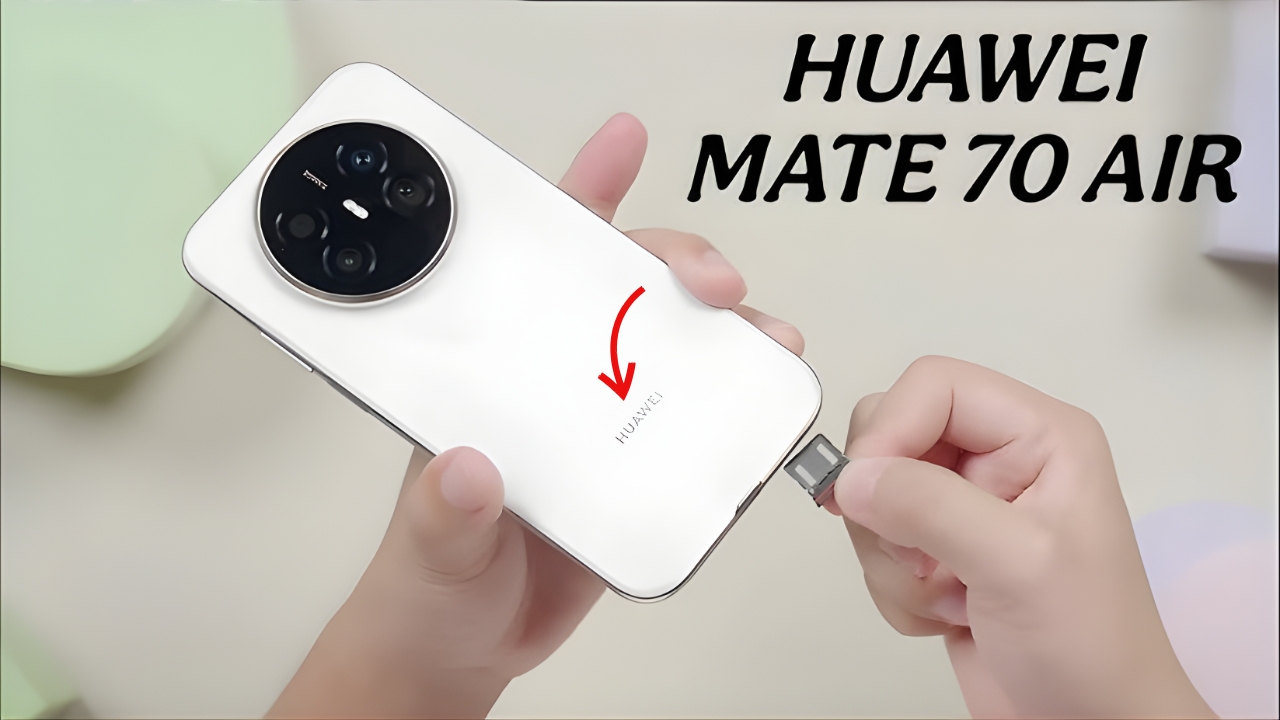
The back adopts a refined glass‑lid design with a circular camera island, and the frame sits snugly between Kunlun Glass at the front and a polished metal‑like finish at the sides, giving it a clean, premium look.
A Bright, Smooth 7‑Inch Display
The centrepiece of the Mate 70 Air is its 7.0‑inch LTPO OLED panel, which runs at a resolution of 1,320 × 2,760 pixels giving roughly an FHD+ output with a 19:9 aspect ratio. This setup delivers sharp text, vibrant content, and very little pixelation when viewed at normal distances.
The display supports 120 Hz refresh rate and up to 300 Hz touch‑sampling, which makes scrolling and gaming feel fluid and responsive.
High‑end extras include 2,160 Hz PWM dimming for reduced eye strain in low light, HDR Vivid support, and a peak brightness of around 4,000 nits, so the screen stays visible even under harsh sunlight.
Dual Kirin Chips for Different Needs
Under the hood, the Mate 70 Air runs on Huawei’s in‑house Kirin 9020 series SoCs, with the 16 GB RAM variant using the Kirin 9020A and the 12 GB RAM models based on the Kirin 9020B, both manufactured on a 7 nm process.
This dual‑chip strategy lets Huawei tune performance and power efficiency for different markets and price points, while still offering a robust octa‑core CPU and integrated GPU capable of handling modern games, multitasking, and heavy apps.
RAM options include 12 GB and 16 GB, paired with 256 GB or 512 GB of internal storage, providing quick‑loading workflows and plenty of space for media‑heavy users.
HarmonyOS 5.1 with AI‑First Touches
The Mate 70 Air ships with HarmonyOS 5.1, which brings a fresh, gesture‑driven interface and a suite of AI‑driven features aimed at boosting productivity and convenience.
Huawei highlights tools such as AI Air Transfer for fast file sharing between devices, AI‑powered noise cancellation on calls, Tap‑to‑Share for quick content passing to nearby devices, and AI face‑swap detection to tighten privacy around biometrics.
The OS also supports stylus‑based annotation, text‑extraction, and AI selection, turning the phone into a light‑duty note‑taking and document‑editing tool for users who rely on real‑time markups.
Quad‑Camera Setup Headlined by 50 MP Sensor
On the imaging side, the Mate 70 Air carries a four‑camera setup, with a 50 MP main sensor at f/1.8 as the primary workhorse, complemented by an optical image‑stabilized telephoto and ultra‑wide lens.
The main camera uses a 1/1.3‑inch sensor, which should help capture more light and detail in mixed‑light conditions, while the telephoto unit offers 3× optical zoom for clearer portraits and distant subjects.
The third lens is an 8 MP ultra‑wide, useful for landscapes and group shots, while a smaller multispectral or depth‑oriented sensor (around 1.5 MP) assists with bokeh and colour‑analysis modes.
For video, the Mate 70 Air supports 4K recording with HDR, optical image stabilization, and gyro‑based electronic image stabilization, so footage stays smooth even during handheld movement.
The front‑facing camera is a 10.7 MP sensor that can record 4K and 1080p clips while offering HDR and panorama modes for better selfie videography.
Massive Battery with 66W Fast Charging
Battery life is where the Mate 70 Air really stands out. The phone packs a 6,500 mAh silicon‑carbon (Si/C) lithium‑ion battery, which is far larger than what most slim flagships offer.
Huawei pairs this with 66 W wired SuperCharge, allowing the phone to top up from low to a usable level in well under an hour, even after heavy usage.
There is no wireless charging, but the 5 W reverse‑wired charging feature can be handy for topping up earbuds or another small device in a pinch.
5G, Wi‑Fi 7+, and Satellite Messaging
Connectivity is built for modern networks, with full 5G support (SA/NSA bands), Wi‑Fi 802.11 a/b/g/n/ac/ax/be (Wi‑Fi 6/7+), Bluetooth 5.2, and L2HC for higher‑bitrate audio streaming.
The Mate 70 Air also integrates multiple GNSS systems, including GPS, GLONASS, BDS, Galileo, QZSS, and NavIC, which helps with more accurate positioning across diverse regions.
In China, the device offers two‑way BeiDou satellite messaging, enabling short text and emergency communications even in remote areas where cellular coverage is weak or absent.
Huawei Mate 70 Air 5G What It Means for Users and Markets
For users who value a thin, large‑screen phone with solid battery life and strong camera performance, the Mate 70 Air delivers a compelling mix of design and hardware.
It may not yet be officially launched in India, indicating that its initial rollout is focused on mainland China and select Asian and European markets, but global availability is expected to follow in the coming months.
Also Read This : Tata Harrier 2026 Bold design SUV comes with ventilated seats and 19 inch alloy wheels
With its focus on AI‑enhanced OS features, future‑ready connectivity, and a slim‑yet‑rugged body, the Huawei Mate 70 Air 5G is shaping up to be one of the more interesting flagship‑style devices of 2025–2026.